Science of Living Things
Meaning of biology
Biology is a branch of science that involves the study of living things. The term biology is derived from two Greek words: BIOS and LOGOS. BIOS means life and LOGOS means to study. Therefore, biology is the study of life.
Branches of biology:
Biology has two branches. These are (i) Botany and (ii) zoology Botany is the study of plant while zoology is the study of animals.
Scientific methods of investigation or inquiry in science.
The scientific method is a systematic approach used to investigate inquiries that arise from observed natural phenomena. When a biology student observes living phenomena, the student uses his scientific method to reveal the mysteries behind the natural phenomena.
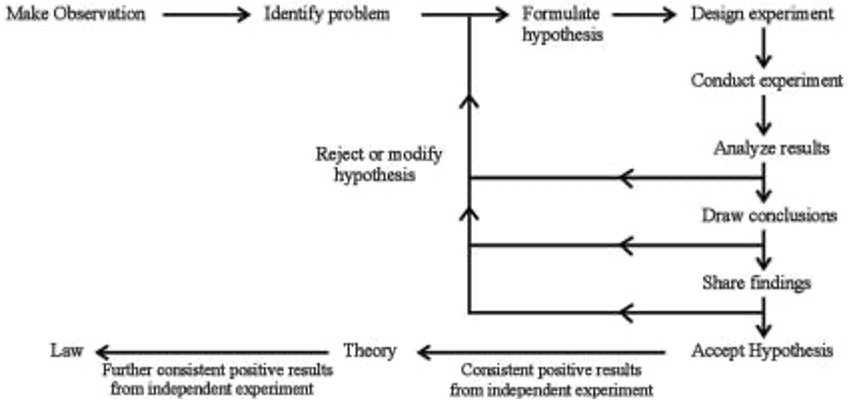
The scientific method includes the following:
- Making observations: This means physical observation of something in the environment. For example, when you look at shoot of plants growing in sheltered area receiving light from one direction, you will observe that the shoot appears to grow towards the brighter areas of the shelter.
- Put forward a possible hypothesis to account for observations: A hypothesis is a scientific or intelligent guess made by a scientist in order to account for the natural phenomenon. For example, from your observation above, you can put forward a theory that says “non-woody shoots of plants respond to light from one direction by growing towards that light”.
- Design and conduct experiments to test the hypothesis. For example, take two similar potted bean seedlings and water them. They should be labeled A and B. Place pot A in a box with a window cut on one side. Light would reach the shoot from one direction only. Place pot B in an identical situation but on a klinostat (a turn table that rotates slowly). This will rotate the plant so that each side of the shoot is exposed to light equally. The seedlings in pot A and pot B should be examined after two days.
- The potted plant labeled “A” will bend towards the source of light rays.
- The seedling in pot B will continue to grow vertically.
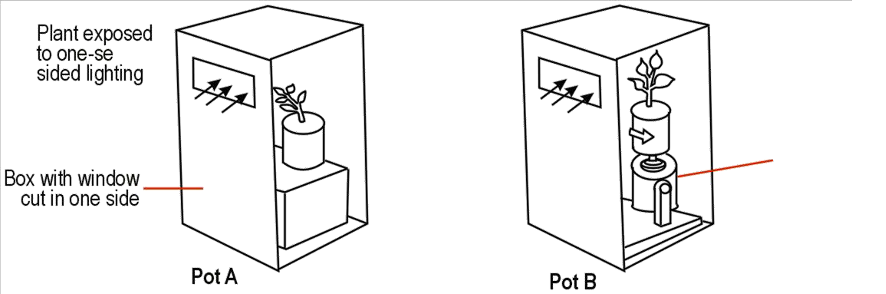 NB: One part of the boxes has been removed to show plant
- Analyse result and draw conclusion: From the above experimental design, non woody shoots of plants respond to one-sided lighting by growing toward light. The result analysed may be those of several experiment. The conclusion is then drawn based on the results of the experiments.
- Accept, reject or modify hypothesis: The hypothesis may be accepted or rejected or modified based on the result of experimental design. If the hypothesis is accepted and proven to be true it becomes a theory (a theory is therefore a tested hypothesis that has been proven repeatedly correct between the limit of available evidence). It is rejected if the result of the experiment are not in line or consistent with the hypothesis.
- Share the results: The results of this study must be shared with other scientists to enable them test the hypothesis, verify it and proceed to carry out further investigation and formulate more hypothesis related to the effect of light and other factors on the various parts of plants. When a theory is tested and proven true extensively, it becomes a principle or a law.
Summary of the method of inquiry in science
Example
Define the term biology and list the two main branches
Answer: Biology can be defined as the study of life. It is also defined as the study of plants and animals.
Main branches of biology
- Botany: which deals with the study of plants
- Zoology: which deals with the study of animals.
Example 2
Biology is the study of
- Animal
- life
- macro-organism
- micro-organism
- plant (2008/1 Neco)
Answer: Life (B) – Biology is derived from two Greek words: BIOS meaning life and LOGOS meaning to study. It is therefore the study of life. The rest options are examples of living things. Option B is the most appropriate Answer.
Controlled experiments
An experiment must be designed to eliminate all bias so as to avoid making false conclusions. To do this, all factors affecting the results of the experiment must be kept constant except the one that is being tested – which is known as the variable. Such experiments are known as controlled experiment.
For example in the experiment to demonstrate that the shoot bend toward the source of light, the variable factor is the lighting. The experimental plant (i.e. Pot A), was exposed to one-sided lighting while the control (i.e. Pot B), was exposed to equal light on all its side (through the use of klinostat) all other factors affecting the experiment were kept constant for both plants.
Usefulness of biology
Biology finds application in the following:
- Agriculture and horticulture: the application of biology in agriculture has helped to develop better and more resistant breed of crops. Secondly, it has helped in the development of insecticides, pesticides and herbicides for the eradication of pests and weeds of crops. It has also led to development of techniques for hastening ripening of fruits. Fishery and animal husbandry has also improved with the application of biological knowledge in reproductive cycles.
- Medicine, dentistry and veterinary science. The knowledge of biology is applied in the development, manufacture and use of vaccines and drugs for prevention and cure of diverse diseases including organ transplant, e.g. kidney transplant.
- Food production industries: most food industries apply the knowledge of biology in their production. For example in the beverage industries, fermentation processes are applied at various level.
- Biotechnology which includes fields like genetic engineering and hybridization technology. This technology is used in producing important cell products such as hormones, vaccine from microorganisms and production of single cell protein such as yeast.
- The development of vaccines and drugs for preventing and treating many serious diseases. An adverse effect of biology is the development of biological weapons. This uses disease causing microbes to attack enemy troops.
Exercise 1.1
- The science of life is referred to as A.anatomy B. biology C. ecology D. phylogeny (2012/1)
- List the stages involved in scientific method.
- State 4 usefulness of biology to man.
- Explain the term controlled experiment.